Consciousness Practices

What Is Shamanic Bilocation? How Shamans Hold Awareness in Multiple Realms

What Is Shamanic Bilocation? How Shamans Hold Awareness in Multiple Realms

One of the most distinctive — and most misunderstood — aspects of Shamanic practice is the ability to hold awareness in more than one place, more than one realm, or more than one perspective simultaneously. In academic and spiritual literature this is sometimes called bilocation. In Shamanic practice, it's simply a skill — one that every practitioner develops over time, and one that underlies nearly everything we do. I want to share with you what Shamanic bilocation actually is, why it matters, and how you can begin to develop it in your own practice.

What Is Shamanic Bilocation?

Bilocation, in its simplest form, is the ability to hold conscious awareness in two places at the same time. Multilocation is holding awareness in multiple places simultaneously.

In Shamanic practice, this comes up constantly, in ways that are both subtle and profound:

  • When you are Shamanic journeying, you are simultaneously present in ordinary reality (you're aware of your body, your breath, the room you're in) and in the spirit realm (you're perceiving, interacting, and receiving information in a non-ordinary state of consciousness). That's bilocation.

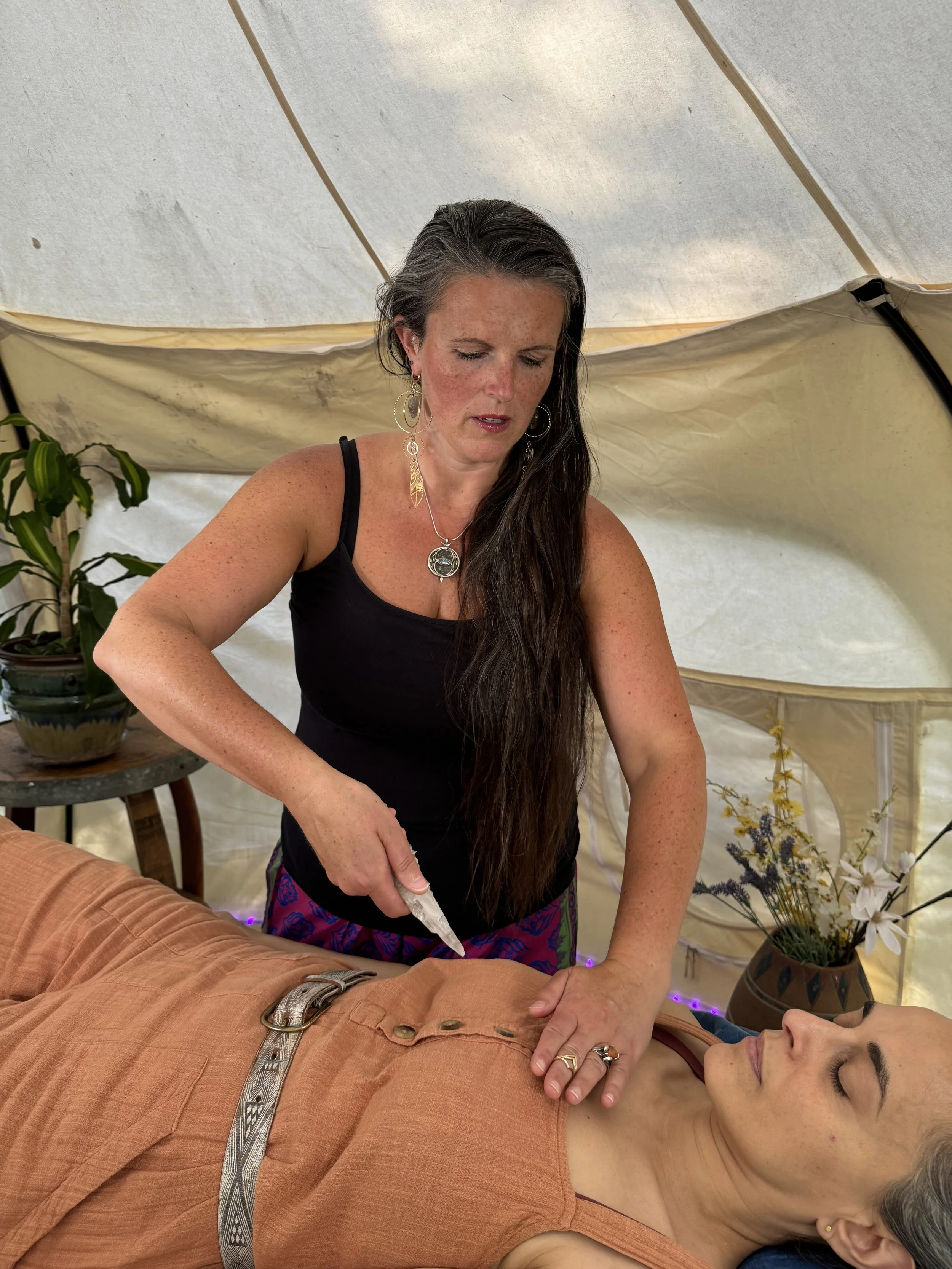
  • When you are doing Shamanic healing work with a client, you're simultaneously tracking their energy field, working with spiritual forces in the spirit realm, maintaining your own grounded presence, and monitoring what's happening in the room. That's multilocation.

  • When you are doing a Shamanic journey for soul retrieval, you are projecting your consciousness to find lost soul fragments — often in other times, other places, other dimensions — while remaining tethered to the present moment. That's bilocation.

The capacity to hold multiple awarenesses simultaneously is not a magical power that only rare Shamans possess. Many people do this intuitively without realizing it. But like any practice, holding multiple awarenesses is a trainable skill, developed through deliberate consciousness practices.

The first time I consciously experienced holding multiple awarenesses simultaneously was in 1997, when I was 10 years old. I was at an ice rink for a party with my friends, and I fell hard and hurt my wrist (I found out later that I had broken a bone). I came off the ice because I was in so much pain, and my friend’s mom came to sit with me. She led me through my very first experience with energy healing, though I didn’t realize until many years later that that was what we had done. She told me that even though it hurt, I didn’t need to shut out or push away the pain — instead, I could bring in soothing light to help ease the pain.

I chose to imagine sparkly, pale blue light. My friend’s mom guided me to imagine that light surrounding my wrist, gently enveloping it with coolness, calm and protection. As I stared down at my throbbing wrist, I felt my perspective shift, and suddenly I could see the light. I became aware not only of the deep pain, but of a tingly sensation that started at my skin and began to permeate inward toward the bone. Looking back, I recognize that I entered a trance state where I was bilocating my energy and attention to offer myself healing.

Why Bilocation Matters for Shamanic Healing

Let's look at why this skill is so important in Shamanic healing work specifically.

When a Shamanic healer works with a client, they need to maintain what I call a divided attention — one foot in ordinary reality, one foot in the spirit realm. This is not the same as being distracted. It's more like what a skilled musician does when they are simultaneously reading music, listening to the ensemble, feeling the physical sensations of their instrument, and communicating with the audience. They maintain multiple streams of awareness, all active, all integrated.

Shamanic Bilocation Healing Trance State Michelle Hawk

In a healing session, the Shamanic healer is:

  • Sensing and tracking the client's energy field in real time

  • Working with spirit guides, communicating and interacting with spiritual forces in the non-ordinary realm

  • Directing healing forces and intentions into the client's field

  • Monitoring their own state — staying grounded, protected, and clear

  • Remaining attuned to what is arising in the present moment of the session

All of this simultaneously.

Without the developed capacity for multilocation, a practitioner tends to collapse into one awareness at a time — fully in the spirit realm and losing track of the client, or fully present with the client and losing access to the spirit realm. The ability to hold multiple streams is what allows for fluid, integrated, powerful healing work.

The Connection to Shamanic Journeying

Shamanic journeying — one of the core practices of Shamanism, the ability to enter an altered state of consciousness and project your awareness into other realms — is itself a bilocative experience.

When you go on a Shamanic journey, you are not asleep. You are not unconscious. You are in an altered state — a trance state — that is closer to lucid dreaming than to ordinary sleep. In this state, you are simultaneously aware of your physical body (you can feel your breath, you are aware of the room, even if only faintly, but you know you can return) AND you are perceiving and interacting in the spirit realm.

This dual awareness is not an accident or a byproduct. It is the point. The Shamanic practitioner maintains a tether to ordinary reality precisely so they can navigate the non-ordinary realm with intention, and bring back what they find. The journey is not a loss of consciousness — it is an extension of consciousness.

And this is exactly what the consciousness practices in the Foundations of Energetic Mastery protocol (part of the Foundations of Shamanism course curriculum) are training. Every time you practice extending your awareness in multiple directions simultaneously through the exercises I teach in the course, you are developing the same “muscles” that you use in Shamanic journeying.

Three Experiences of Bilocation in Daily Life

Before we assign bilocation as a capacity specific to Shamanism, it's worth noticing that most people have already experienced versions of it in normal life:

Lucid dreaming. In a lucid dream, you are simultaneously in the dream world and aware that you are dreaming — aware enough to make choices, change the dream, explore deliberately. That double awareness is bilocation.

Deep empathy or attunement. When you are deeply present with another person in grief or pain — when you can feel what they feel while still remaining yourself — that's a form of bilocation. You are fully connected with their experience AND maintaining your own perspective.

Flow states. Athletes, performers, and healers in deep flow often report an experience of being both fully immersed in what they're doing AND watching it from a slight distance — aware of themselves performing and doing the performing simultaneously.

These experiences are not random. They're glimpses of the same capacity that Shamanic practice cultivates deliberately.

When my students learn about bilocation, many of them realize that they’re already unconsciously experiencing this, often during activities where they suspend their normal mental processes — they receive creative inspiration while out walking, they hear messages from guides while gardening or cleaning the house, or they become aware of the collective field while out dancing. They already have the experience of holding multiple awarenesses simultaneously — I help them cultivate skill and learn practices so they can do so intentionally, purposefully and apply this skill in their spiritual practice.

A Simple Practice for Developing Bilocation

Here is a practice I teach in the Foundations of Shamanism course that directly develops the bilocative capacity.

The Tiny Self exercise:

Sit comfortably with your eyes closed. Take a few deep breaths to arrive in presence. With your hands resting palm up on your legs, project a tiny version of yourself — perhaps an inch tall — to stand in the palm of one of your hands.

Now enter the perspective of your tiny self. Look down at the palm beneath your feet. Feel the warmth. Touch a finger like a tree trunk. Look around the room from this new vantage point. Look up and see your full-size face looking down at you.

Now jump your awareness back to your full-size self, looking down at your tiny self. Then back to the tiny self. Alternate several times.

Finally, hold both perspectives simultaneously. You are the tiny self looking up, AND you are the full-size self looking down. Both are real. Both are you. Both are present at the same time.

This is energetic bilocation. And it is a direct precursor to the dual awareness required in Shamanic journeying.

What This Is Not

I want to be clear about something: developing bilocative awareness in Shamanic practice is not the same as dissociation. It is not losing touch with reality. It is not leaving your body in an ungrounded way.

The Shamanic practitioner who billocates skillfully is more grounded, not less. They are more present in their body, not absent from it. The capacity to extend awareness into the spirit realm is developed alongside — not instead of — strong roots in the physical world. Grounding and bilocation go together. They are not opposites.

This is precisely why the Foundations of Energetic Mastery protocol I teach in the Foundations of Shamanism course builds in the order it does: consciousness practices first, then clearing, grounding, centering, cultivation and protection. By the time you are doing advanced bilocation in journey work or healing sessions, you have a deeply rooted, well-maintained energy body that can hold the extension without losing its foundation.

Ready to Develop This Capacity?

Shamanic bilocation is one of many skills developed in the Foundations of Shamanism course — my 11-week live online Shamanic training program. We begin with consciousness practices exactly like the ones described here, and build systematically toward Shamanic journeying, spirit guide communication, healing work, and more. Join the wait list and be the first to know when registration opens this fall!

If you're drawn to developing these capacities in a personal, supported way, 1:1 Shamanic Mentorship offers a container for exactly that.

And if you're just beginning to explore Shamanism and want a gentle, grounded entry point, my free guide, Activate Your Shamanic Gifts, is a great place to start — my gift to you.

How to Develop Your Shamanic Senses: A Guide to Sensing, Feeling, Projecting and Directing Energy

How to Develop Your Shamanic Senses: A Guide to Sensing, Feeling, Projecting and Directing Energy

One of the most common questions I receive from people beginning a Shamanic practice is some version of: "How do I know if what I'm experiencing is real, or if I'm just making it up?" It's a beautiful question, and it points to something essential about Shamanic development — the cultivation of energetic fluency. In Shamanic practice, your ability to consciously sense, feel, project, and direct energy is not a mysterious gift that some people have and others don't. It's a skill. And like any skill, it develops through practice. In this article I'm going to walk you through exactly what these skills are, how they work, and how to begin developing them.

The Two Core Skills of Shamanic Consciousness Practice

At the foundation of all Shamanic energy work are two core capacities:

Sensing and feeling — the ability to perceive, receive, and notice energy: in your body, in your field, in the space around you, and in others. This is the receptive, listening side of energetic work.

Projecting and directing — the ability to move, transfer, and guide energy with intentional awareness. This is the active, expressive side of energetic work.

Every Shamanic practice draws on both of these. When you are Shamanic journeying to connect with a spirit guide, you are sensing and feeling — receiving information, images, sensations, and messages. You are also projecting — sending your consciousness into the spirit realm and directing your intention toward what you are seeking.

When you are working as a Shamanic healer with a client, you are sensing and feeling their energy field — perceiving blockages, intrusions, soul loss, and areas of depletion. And you are directing — inviting healing forces into their field, guiding energy to move, directing extraction work.

The two skills work together. Both are learnable and can be developed with practice, and the help of validation.

During my very first Shamanic training in 2003, I swallowed my initial anxiety (would I be able to do this? Is this real?) and dove right into trust and surrender of what I was sensing. We practiced Shamanic journeying in pairs, and when I shared with my partner what I had sensed and felt on her behalf, she quickly validated everything I had perceived as extremely accurate, helpful and relevant for her. I felt relieved to have many experiences like this early in my practice, that allowed me to build trust and confidence in my ability to accurately perceive energy. This helped me build a strong foundation for my growing Shamanic healing work and allowed me to consciously develop my skills.

"Am I Making This Up?" — The Question Every Beginner Asks

Let me speak directly to the doubt that most beginners carry.

When you extend your awareness into a space, into a body, or into the spirit realm, and you notice something — a sensation, an image, a feeling, a knowing — a part of your mind will immediately ask: "Is that real, or am I imagining it?"

Here is what I want you to know: the imaginal intelligence is real intelligence. The faculty of imagination is not the opposite of perception — it's a type of perception. The Shamanic realms and the beings who inhabit them communicate through exactly this channel: images, feelings, sensations, symbols, knowing.

When I first began my Shamanic practice in 2003, I felt the same concern I hear from many of my students — “how do I know I’m not just making things up?” But when I asked my teachers about it, they all encouraged me to embrace what I perceived as my imagination. From the Shamanic perspective, imagination is a valid sensory intelligence that allows the practitioner to transcend beyond ordinary reality into subtle realms of perception and collaboration with spiritual forces.

The way you develop trust in your perception is not by waiting to be sure before you act on it. It's by practicing, noticing, journaling, and tracking what happens over time. You begin to build a body of experience that tells you: yes, when I sense something in that particular way, it tends to be accurate.

This is why consciousness practices — the exercises for sensing and feeling, and projecting and directing — are so important. They build the muscle. They make the channel clearer, more consistent, and more trustworthy over time.

Three Exercises I Teach in the Foundations of Shamanism

Here are three consciousness practices I teach in the Foundations of Shamanism course to help students develop energetic fluency and confidence. You can begin working with them on your own.

Exercise 1: Sensing and Feeling in Space

Sit comfortably with your eyes closed and your hands resting palm up on your legs. Take a few deep breaths to arrive fully present.

Shamanic Sensing Energy Michelle Hawk

Front and behind: Extend your attention to the space in front of your body. Feel it. Notice any objects there, and then feel beyond them — all the way to the wall in front of you, and maybe beyond. Then shift your attention to the space behind your body. Do the same. Then extend in both directions simultaneously. Notice whether one direction is easier than the other.

Sides, above, below: Repeat this process for the space to your right, your left, above your head, and below your feet. Then both sides simultaneously, both above and below simultaneously, and finally, all directions at once — 360 degrees around you in a sphere.

The expansion-contraction breath: On your inhale, draw all of your awareness as deep inside yourself as possible — compressed like a tiny, dense marble of light. On your exhale, expand your awareness out in every direction simultaneously, as far as you can. Repeat several times.

What this develops: Multi-directional awareness. The ability to sense and feel what is all around you simultaneously. In Shamanic journeying and healing work, this translates to the capacity to hold attention in multiple directions, dimensions, and relationships at once — what I call energetic bilocation and multilocation. This practice also supports the foundation of intentionally directing your energy through expansion and contraction. This direction can later be refined.

Exercise 2: The Layers of the Body

This is a practice in sensing and feeling into the interior of your own energy body.

Choose one hand. Bring your attention to it completely. Then move your awareness through the layers, one at a time, from outside in:

  • The skin — feel the air on your skin, the warmth, the texture

  • The muscles — feel their warmth and strength

  • The blood — feel the current, maybe feel your heartbeat in your thumb

  • The bones — feel the crystalline, mineral structure

  • The marrow — that spongy tissue where new blood is born

  • The light at the core of the marrow — your starseed consciousness

Then hold all layers simultaneously. Then transfer that full awareness to your other hand. Then jump back to the first. Then both hands simultaneously. Then slowly expand that whole-body awareness through your wrists, arms, shoulders, neck, head, chest, abdomen, hips, and all the way down to the tips of your toes.

What this develops: Precision of attention, depth of sensing, and the ability to project and direct awareness with intention. The "jumping" is projecting. The holding of all layers simultaneously is an advanced form of perceptual multilocation.

Exercise 3: The Tiny Self

This is a practice in deliberate perspective-shifting and Shamanic bilocation.

Project a tiny version of yourself — perhaps an inch tall — to stand in the palm of one hand. Then enter the perspective of that tiny self. Feel the squishy palm beneath your feet. Wrap your tiny arms around a finger like a tree trunk. Look up and see your full-size face above you.

Then jump your awareness back to your full-size self, looking down. Then back to the tiny self. Then jump your tiny self to your other hand. Then hold both perspectives simultaneously — the tiny self looking up, and the full-size self looking down — at the same time.

What this develops: Deliberate bilocation. The ability to project consciousness to another location and perceive from there. This is directly related to the kind of consciousness we work with in Shamanic journeying, soul retrieval, and healing work with clients — where we are simultaneously present in ordinary reality and in the spirit realm.

Over the years, I have found that students tend to already feel comfortable with one area of these exercises, and deeply challenged by others. Students who have an existing meditation or embodiment practice often feel very confident sensing the layers of the body, or the space around them. But many students feel challenged when asked to “jump” their awareness back and forth between their hands, feel into multiple directions simultaneously, or to shift their consciousness into their tiny selves. I have seen many students experience initial frustration (especially at the bilocation and projecting consciousness exercises), only to go practice for two weeks and happily report a newfound confidence and capacity.

The Connection to Shamanic Journeying

Everything in these three exercises is preparation for Shamanic journeying and Shamanic healing work.

In Shamanic journeying, you deliberately enter an altered state of consciousness — a trance-like state — in which you can access the spirit realm, connect with guides and teachers, and receive information and healing. This state is accessed through exactly the same capacities these exercises develop: the ability to extend your consciousness beyond your ordinary perception, to hold awareness in multiple realms simultaneously, to shift perspective, and to project and direct your attention with intention.

The altered state is not exotic or inaccessible. Many people enter it naturally — in dreams, in deep meditation, in moments of lucid waking, in flow states. The difference that these practices create is that you can enter it deliberately, safely, and skillfully — with a clear beginning and end, so that you're in collaborative, skilled relationship with the energy and the realms, rather than being at the whims of whatever happens to arise.

This is the difference between energy happening to you and being in conscious, collaborative relationship with energy.

How to Practice: Practical Suggestions

Daily practice: Even ten minutes a day with one of these exercises is excellent. Everything is cumulative and builds on itself. Use the exercises as a practical devotion — not something you do perfectly, but something you do consistently.

Work with nature: These practices come alive outdoors. Stand in front of a tree and extend your sensing into its energy body. Feel the layers — bark, sap, rings, heartwood. Project your tiny self up into a branch. Stand in a forest or a field and extend your awareness in all directions, feeling the energy of everything around you.

Journal: After each practice, take a few minutes to write down what you noticed. Over time, your journal becomes a record of your development — and a body of evidence that your perception is real, specific, and trustworthy.

Be patient with the doubt: The question "am I making this up?" is not a sign that something is wrong. It's a sign that you're doing something real enough to challenge your ordinary sense of what is possible. Stay with the practice. The trust comes.

Ready to Go Deeper?

Consciousness practices are just the base of the pyramid of energetic mastery. In the Foundations of Shamanism course, we move through all six layers of Energetic Mastery — consciousness, clearing, grounding, centering, cultivation, and protection — and you learn how to Shamanic journey, work with spirit guides, develop energetic safety and mastery, and build a grounded, meaningful personal practice over eleven weeks of live online classes.

If you're looking for personalized support in developing your Shamanic senses, Shamanic Mentorship offers a 1:1 container for exactly that kind of deep, sustained development.

And if you're just beginning, my free guide, Activate Your Shamanic Gifts, is the perfect starting point. It's free, and it will help you take your first real steps.